
Most rural nights have a soundtrack, and after the wind drops, three birds do most of the talking. A great horned owl, a barred owl, and a barn owl can each sound odd enough to make you stop halfway across the yard and wonder what you're hearing. Telling them apart is less about perfect pitch than about rhythm. Listen for the pattern, the spacing between notes, and how high or low the voice sits, and you can name the bird in the dark without ever laying eyes on it. A phone held up for thirty seconds does the rest — these calls are far easier to sort out on a second hearing, when you already know what to expect.
Three Voices to Learn First
Each of these owls calls at a different pitch, on a different schedule, and from different ground. Sort those three things out and most nighttime identifications take care of themselves.
- Great horned owl: the lowest voice of the three, steady rhythmic hooting, most vocal in winter.
- Barred owl: mid-range and almost conversational, with a drawn-out final note; at home in mature woods near water.
- Barn owl: no hoot at all — a long, harsh screech over open fields, hay meadows, and old buildings.
Here's a shortcut: if you can hum it back easily, it's probably a barred owl. If it feels too low to hum and you mostly notice it in your chest, it's a great horned owl. If it isn't a hoot at all and makes you look for a fence-line intruder, it's a barn owl.
The Great Horned Owl: A Hoot You Feel More Than Hear
The great horned owl's call sits so low that on some nights you notice it in your chest before your ears catch it. It's a soft, breathy series, usually five syllables, with the middle notes running together: hoo hoo-hoo, hoo, hoo. Birders remember it as "Who's awake? Me too." The volume is modest — no shouting — yet calm, cold air carries it a long way, which is why the bird often sounds closer than it is.
Pairs duet, and the two voices aren't identical. In owls the female is generally the larger bird with the higher voice, so listen for one hoot sitting a step above the other, answering and overlapping. Hooting picks up in early winter, when pairs are reasserting bonds and territory; across much of North America these owls are on eggs by late winter, long before most other birds have thought about nesting. A January evening with two birds trading hoots across a stubble field is one of the most reliable owl encounters you can plan for.
The hoot isn't the only sound in their repertoire. An agitated great horned owl barks — short, sharp notes in a rough series, sometimes described as a dog with a sore throat. Adults and begging young can also produce a shriek that sounds uncomfortably like a person in distress. If a scream comes from high in a tree and stops as suddenly as it started, that's often an owl rather than anything with fur.
The Barred Owl: A Question in the Dark
The barred owl's call is the one people can actually repeat back. It's rhythmic and clearly spoken, eight or nine syllables, ending in a drawn-out note that slides downward: "Who cooks for you? Who cooks for you all?" The accent falls at the start of each phrase, and that final hanging syllable is the giveaway. The voice sits higher than a great horned owl's and has a fuller, more hollow tone.
Barred owls often answer each other, and the female's reply — a rising hoo-wah — can make a single bird sound like two. A lone owl may also give a single hoot at long intervals, a contact call that's easy to miss if you're not listening for it. These are birds of mature woodland, wooded swamps, and river bottoms, and they're most familiar in the eastern states and the Pacific Northwest. They'll hunt crayfish and frogs along a creek bank as happily as they'll take a mouse.
Their range is still shifting. Barred owls have spread westward across the northern forests over the past century, and where they meet the endangered spotted owl they sometimes hybridize — one reason a barred owl hooting in an old-growth stand in Oregon is now a management headache rather than a novelty.
The Call That Wakes the Whole House
Sooner or later you'll hear a barred owl pair caterwauling — a wild jumble of cackles, screeches, and manic hoots that sounds like monkeys arguing or a flock of crows being murdered. It usually isn't a fight. It's a duet, and it can go on for a minute or more before cutting off into silence.
The Barn Owl: The Call That Isn't a Hoot
If you've ever heard something in a hayfield that made you walk out and check the fence line, it was probably a barn owl. Barn owls don't hoot. They screech — a long, raspy, drawn-out scream of a couple of seconds, like a rusty hinge forced open or a hiss pushed through a pipe. They often call while flying from post to post, so the sound seems to travel across the field and then stop.
Near a nest or roost you'll hear a different vocabulary entirely: clicks, hisses, and a snoring rasp from the young that carries through a barn wall and can be mistaken for livestock settling in for the night.
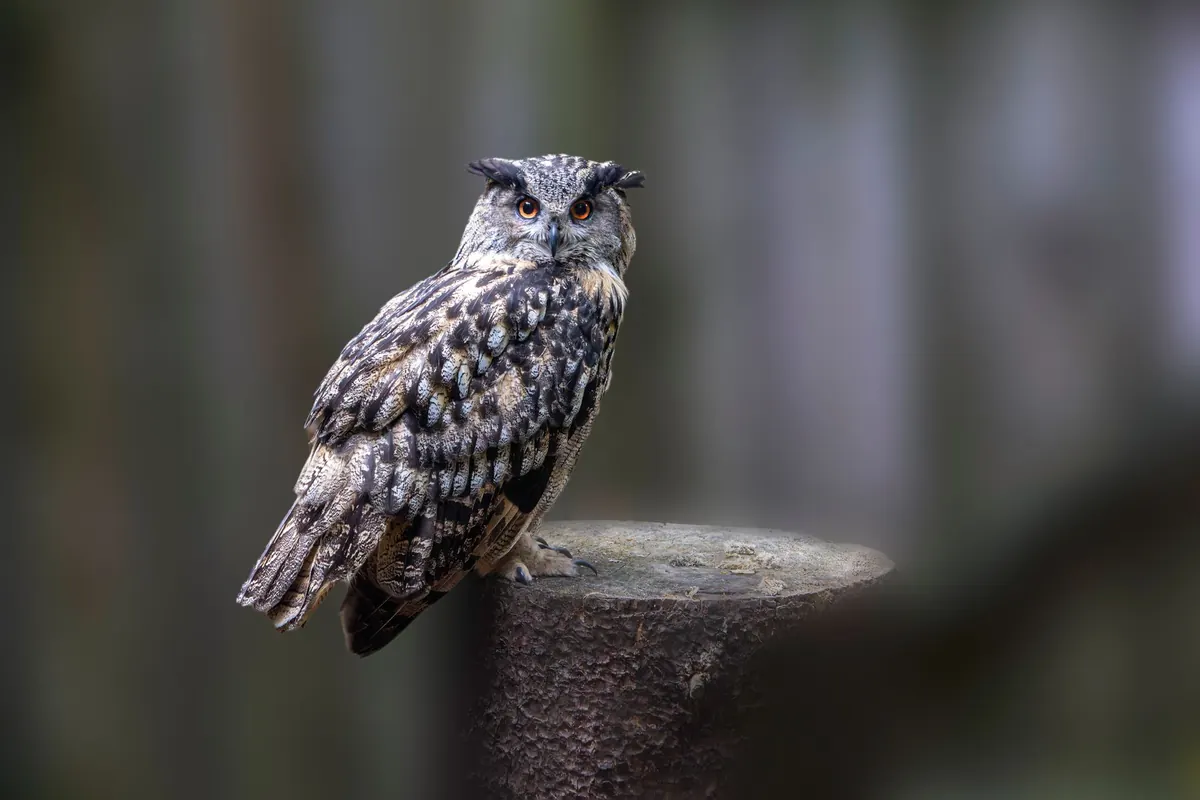
Look for them over open country — pasture, hay meadow, marsh edge — and around the buildings that go with it: barns, silos, sheds, church towers. A barn owl is pale and long-winged, with a white, heart-shaped face and a moth-like flight so quiet you'll see the shape cross a porch light before you hear anything at all. That silence is part of the identification: a big, pale bird drifting low over a field without a whisper of wing noise, then a screech from the next post down the line.
Two More Owls Worth Knowing
Once the big three are sorted, two smaller voices start to stand out — and both are easy to confuse with background noise.
- Northern saw-whet owl: a single, clear, repeated toot at roughly one per second, going on for hundreds of notes. People describe it as a truck backing up, or a smoke alarm with a dying battery. It's a small owl with a surprisingly carrying voice, most vocal in late winter and early spring.
- Eastern and western screech-owls: a soft, descending whinny — like a tiny horse — often followed by a steady tremolo on one pitch. The whinny is the signature; the tremolo is the alarm.
Neither hoots in the great horned sense, and neither screeches like a barn owl, so once you've heard each one twice you'll rarely mix them up again.
How to Confirm What You Heard
Night identification rewards a little discipline. When something calls, resist the urge to guess immediately and work through it in order.
- Count the rhythm. Five slow hoots, eight or nine rhythmic ones, one continuous screech, or an endless flat toot — the pattern narrows it to a species before pitch even matters.
- Note the pitch relative to others you know. Lower than a mourning dove's coo points to great horned; in the range of a human speaking voice points to barred.
- Check the date. Great horned owls peak in midwinter, barred owls call year-round but loudest in late winter and spring, barn owls screech in any month.
- Check the habitat. Woods and water mean barred; open field and farmstead mean barn; anywhere with tall trees and a big territory can mean great horned.
- Record it. A thirty-second clip settles arguments later, and apps or local birders can confirm what your ears only half caught.
Rule of thumb: rhythm first, pitch second, habitat third — and never trust a single hearing on a windy night.
Spend a few evenings listening with those three questions in mind and the darkness stops being anonymous. You'll start recognizing the low winter hoot before you're fully awake, the conversational question from the creek woods, and the field-edge screech that never was a person in trouble after all.
Photo: Erik Karits / Pexels